

I. Rigid PVC Compounding Process
- Main Raw Material: PVC resin serves as the base material; resins with appropriate polymerization degrees and particle size distributions are typically selected to meet processing and performance requirements.
- Stabilizers: Heat stabilizers—such as lead-based or calcium-zinc stabilizers—are essential to enhance the PVC's thermal stability and prevent decomposition caused by high temperatures during processing.
- Lubricants: These include both internal and external lubricants. Internal lubricants facilitate initial material gelation, while external lubricants prevent excessive adhesion to processing equipment, ensuring proper material flow and processability.
- Impact Modifiers: Additives such as ACR are used to improve the product's impact resistance; high impact resistance is a critical quality indicator for rigid PVC profiles and foamed sheets.
- Fillers: Materials such as calcium carbonate are used to reduce costs and increase product rigidity. In rigid PVC profiles, appropriate filler content can enhance dimensional stability and hardness.
- Other Additives: Color masterbatches, antioxidants, and other agents are added as needed to impart specific colors and oxidation resistance to the profiles or foamed sheets.
| Component | Typical Ratio | Function | Common Types |
|---|---|---|---|
| PVC resin | 80–95% | The matrix material determines the rigidity of the product. | K-value 60–68 (high molecular weight, e.g., SG-5, SG-7) |
| Stabilizer | 3–5% | Prevent thermal decomposition and extend the processing window. | Lead-based stabilizers (tribasic lead sulfate, dibasic lead phosphite) and calcium-zinc composite stabilizers (eco-friendly type) |
| Lubricant | 1–2% | Reduce friction and balance internal and external lubrication. | Internal lubricants: stearic acid, stearyl alcohol; external lubricants: PE wax, oxidized polyethylene wax. |
| Filler | 10–30% | Reduce costs and enhance dimensional stability. | Ground calcium carbonate (particle size 1–5 μm), activated calcium carbonate (surface-treated) |
| Processing aids | 1–3% | Improve melt flowability and reduce plasticization time. | ACR (acrylics), CPE (chlorinated polyethylene), modifiers (elastomer-grafted) |
| Modifier | 0.5–2% | Improve impact resistance. | MBS (Methyl Methacrylate-Butadiene-Styrene Copolymer) |
II. Rigid PVC Hot/Cold Mixing Process
Hot Mixing Process
- Process: Driven by high-speed rotating mixing blades, the materials rapidly disperse along the inner wall of the mixer and fall back, creating a vortex-like motion. Under the shear forces generated by the impact and friction between the materials, the mixing blades, and the mixer walls, the material transforms from a solid, single-phase, heterogeneous state into a multi-phase, homogeneous, and partially gelled state, while the material temperature steadily rises.
- Functions: Induces a certain degree of gelation; allows low-melting-point substances (such as lubricants) to melt and either penetrate or adhere to the PVC surface; achieves effective initial gelation and dispersion; increases apparent density, thereby improving flowability for easier transport and higher extrusion efficiency; and removes moisture and low-volatility components from the raw materials.
- Temperature Control: The final discharge temperature for hot-mixed rigid PVC profiles is typically 110–120°C. When the calcium carbonate content is high, the discharge temperature may be raised slightly to facilitate the uniform adsorption of calcium carbonate by the PVC and low-melting-point components, thereby increasing the apparent density.
- Feeding Sequence: First, add PVC resin and heat stabilizers at low speed; then, add impact modifiers, processing aids, and internal lubricants at high speed and 60°C; finally, add fillers, titanium dioxide, ultramarine blue, external lubricants, UV stabilizers, masterbatches, and antioxidants at high speed and 80°C.
- Batch Size: Generally, each batch should be controlled at approximately 75% of the hot-mixing tank's capacity to avoid excessively long (or short) mixing times, which could lead to over-plasticization (or uneven plasticization) of the material.
1. Process Flow
Order of addition:
PVC resin → Stabilizer → Filler (added in batches) → Lubricant → Processing aid
Note: Add filler in 2–3 batches to prevent agglomeration; add lubricant last to avoid encapsulating other components.
Temperature and time control:
- Heating stage: Initial temperature 50–60°C; ramp up to 100–110°C within 5 minutes.
- Plasticization stage: Maintain 110–125°C for 8–12 minutes (until the material appears as a dry powder without lumps).
- End-point determination: Material temperature reaches 120°C ± 2°C, and torque stabilizes.
2. Key Control Points
- Temperature uniformity: Agitator speed of 800–1200 rpm to ensure uniform heating of the material.
- Volatile discharge: Slightly open the hot mixer exhaust valve to vent moisture and low-boiling-point impurities.
- Degradation prevention: Discharge material immediately if the temperature exceeds 130°C to prevent PVC decomposition (HCl release).
3. Equipment Requirements
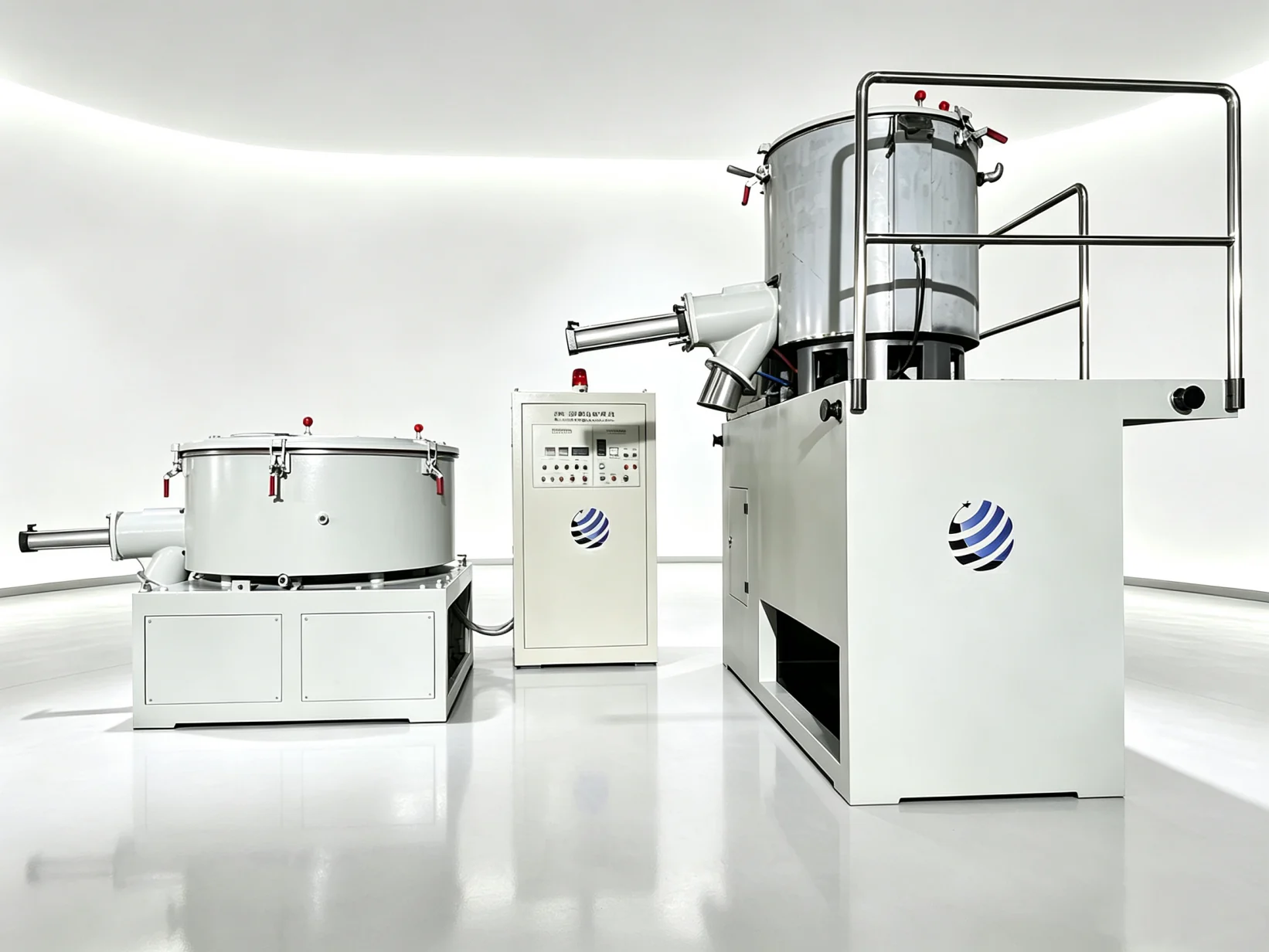
- High-speed hot mixer: Equipped with double-layer S-type mixing blades, a heating jacket, and temperature sensors.
- Power matching: A 500L capacity hot mixer requires a 55–75 kW motor to ensure high torque output.
Cold Mixing Process
- Principle: The cold mixer features a jacketed vessel through which cooling water flows. Material discharged from the hot mixer enters the cold mixer; within the spacious chamber, continuous agitation and tumbling by rotating blades allow heat to be absorbed by the cooling water in the jacket, causing the material to gradually cool down.
- Function: It prevents moisture re-absorption (hygroscopy) that can occur when PVC material cools from high temperatures and facilitates the further removal of intermolecular moisture during the heat dissipation process.
- Temperature Control: The rated discharge temperature is typically 40°C, with cooling water temperature usually maintained between 13°C and 15°C.
1. Process Objectives
- Cooling: Rapidly cool the hot-mixed material from 120°C to below 40°C.
- Anti-agglomeration: Loosen the material through low-speed agitation (200–400 rpm).
- Stabilization: Produce a uniform, dry premix suitable for storage and extrusion.
2. Process Parameters
- Cooling Rate: Cool to 40°C within 5–8 minutes (jacket water temperature ≤15°C).
- End-point Control: Material moisture content <0.3%; particles remain loose without clumping or adhesion.
3. Equipment Configuration
- Cold Mixer: Inclined design with a jacket for circulating cooling water.
- Wall Scraper: Prevents high-filler formulations from adhering to the inner wall.
III. The Core of the Rigid PVC Process
- Formulation Rigidity: Achieving high strength through a high resin ratio and appropriate filler selection.
- Thorough Plasticization in Hot Mixing: High-temperature, high-speed mixing ensures uniform dispersion and pre-plasticization of all components.
- Rapid Stabilization in Cold Mixing: Prevents material agglomeration and provides a stable feed source for extrusion.
- Equipment Suitability: High-torque mixers and efficient cooling systems are both essential. By precisely controlling hot-mixing temperatures, cold-mixing rates, and formulation synergy, the mechanical properties and surface quality of rigid PVC products can be significantly enhanced while reducing energy consumption and scrap rates, thereby enabling efficient production in sectors such as profiles, pipes, and sheets.